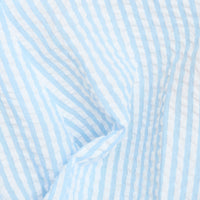
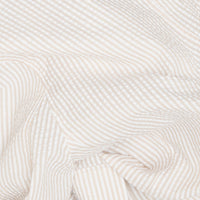
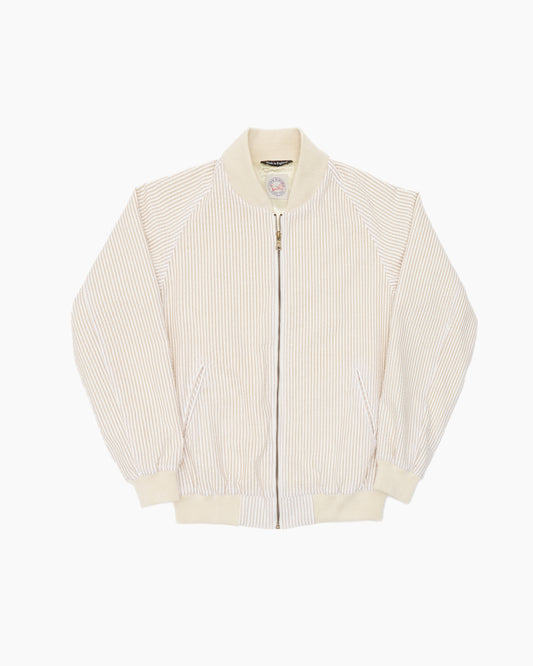
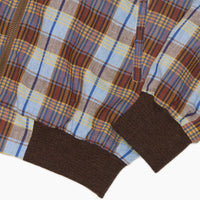
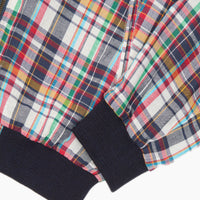
Much like its colourful counterpart, Madras, Seersucker is most definitely deserving of a chapter within the history of Ivy. One need only glance at the pages of Reel Art Press’ Jazz Festival for a veritable smorgasbord of Seersucker action, as the fabric was utilised in all manner of clothing during the Ivy League boom years, including: soft shouldered Ivy jackets and slacks, square end ties, bucket hats, and of course, short sleeve button down shirts.


Seersucker derives its name from the Persian phrase ‘shir-o-shakhar’ meaning milk and sugar, a nod to the fabrics alternating textures. Seersucker is a lightweight fabric, featuring a puckered texture which is created by weaving groups of different threads together. The construction sees the puckered threads woven at a greater rate than the warp thread of the smooth areas of the cloth, creating the distinctive crinkle inherent to the fabric. Seersucker is often referred to by the more colloquial moniker of Railroad stripe, a term which refers to the fact that Seersucker fabrics will often feature a striped pattern, typically in light blue and white, which complements the vertical lines inherent to the cloth.


First popularised in India and other hot climates, during the early 20th Century, the lightweight nature of Seersucker, as well as its somewhat permeable construction, means that it is extremely breathable and ideal for the summer months. It is perhaps one of the few ways in which a sweaty Ivyist can hope to remain suited once the temperatures start to rise. In addition to this functionality, the crinkled appearance of Seersucker brings with it another benefit – no need to iron! This is of course a key trope within Ivy style and its inherent duality, where louche, uncouth and casual, naturally meet and mesh with the refined, sharp and conservative.
This summer, be like Quincy and wear Seersucker!


Editorial Photography by Alex Natt.
See our Seersucker Collection below.